
Where Fire Meets Water: The Raw Drama of El Golfo and Los Hervideros
While Timanfaya National Park is a testament to the Earth’s fiery birth, the southwest coast of Lanzarote—where the lava flows finally surrendered to the Atlantic Ocean—is the setting for a more dynamic and haunting drama. Here, at El Golfo and Los Hervideros, the raw, black basalt of the Fire Mountains clashes endlessly with the powerful blue sea, creating scenes of spectacular, eroding beauty.
These two sites are more than just viewpoints; they are essential lessons in geological contrast, offering some of the island’s most compelling insights into the enduring power of nature.
1. El Golfo: The Emerald Eye of Lanzarote
To witness El Golfo is to see a landscape caught in an ongoing process of decay, yet radiating astonishing colour. The site is the remains of a massive volcano that has been partially eroded by the ocean over centuries.
The Spectacle of Colour: Lago Verde
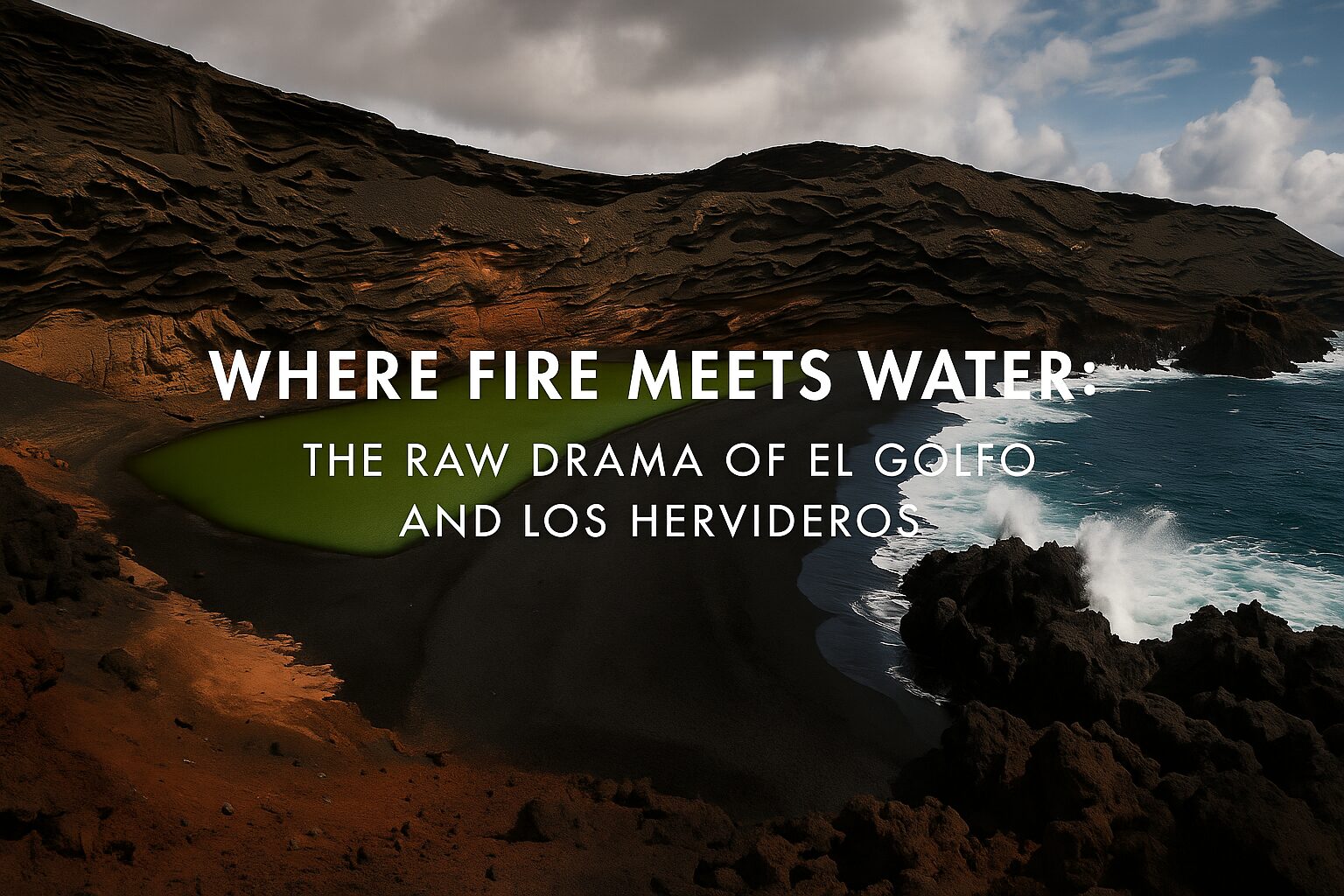
The highlight of El Golfo is the Charco de los Clicos, better known as the Green Lagoon (Lago Verde). This brilliant, emerald-green pool is nestled dramatically in the black sands at the base of the half-submerged crater.
- The Secret to the Green: The striking colour is not a trick of the light, but the result of the high concentration of sulfur and the presence of a unique type of phytoplankton (algae) that thrive in the mineral-rich waters. The lagoon is separated from the sea by a narrow strip of black volcanic beach, creating a vibrant triptych: the deep blue of the Atlantic, the charcoal black of the volcanic sand, and the luminous green of the lagoon.
- The Best View: Access to the lagoon itself is forbidden to protect its delicate ecosystem. The experience is best viewed from the designated clifftop lookout point (Mirador), reached via a short, gentle walk from the parking area. The afternoon sun often brings out the deepest green hue.
A Note on Preservation
The Charco de los Clicos is a natural reserve. The scattered chunks of black and red lava rock are protected specimens, polished smooth by the elements. Respect the barriers; the beauty of El Golfo lies in its fragility as much as its drama.
2. Los Hervideros: The Boiling Place
A short drive south from El Golfo, the coastline transforms into a savage display of nature’s might. Los Hervideros translates literally to “The Boiling Places,” a name earned by the phenomenal interaction between the ocean and the ancient lava flows.
The Architecture of the Lava
When the lava from the Timanfaya eruptions poured into the sea, the rapid cooling caused the molten rock to fracture and solidify into incredible, intricate formations. The result is a series of underwater caves, blowholes, and jagged sea cliffs.
- The Thrill of the Crash: The sheer kinetic energy here is palpable. As the powerful Atlantic waves surge, they are funnelled violently through the subterranean tunnels and crevices in the basalt. The water explodes upwards and inwards, creating a dramatic, churning spectacle that truly makes the water appear to “boil.” The noise is deafening, a visceral reminder of the unstoppable force of the sea.
- The Walk-Through Caves: Unlike many restricted coastal areas, Los Hervideros has a series of paths, viewing balconies, and carefully carved openings that allow visitors to walk inside some of the lava tubes. From these protected vantage points, you can look down into the raging caverns and watch the waves rush in and out, feeling the spray and the roar of the ocean directly below your feet. This immediate, close-up access makes Los Hervideros a unique and highly dramatic stop.
3. Janubio Salt Flats: The Unexpected Contrast
No tour of the southwest coast is complete without acknowledging the Salinas de Janubio. Positioned between the chaotic drama of the volcanoes and the sea, these salt flats provide a striking, man-made contrast.
- A Patchwork of Purity: The Janubio salt pans create a vast, geometric quilt of colours—from white and pink to deep ochre—depending on the salt concentration and the time of day. This is the largest functioning salt producer in the Canary Islands, built in the shadow of a volcanic crater. The stark, geometric lines of the pans offer a moment of tranquil symmetry against the backdrop of the rugged coast.
- Best Time to Visit: Visit near sunset when the low light illuminates the salt crystals and enhances the pink and red hues of the water, offering a breathtaking photography opportunity.
The West Coast: A Concluding Thought
The West Coast of Lanzarote—stretching from the edge of Timanfaya down to the Salinas—is the island’s raw heart. El Golfo provides the colour, Los Hervideros provides the sound, and the Salinas provide the stillness. Together, they create an unforgettable, multi-sensory experience that defines the savage, beautiful character of the island.